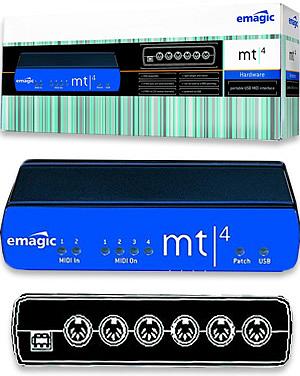
Emagic Mt4 Midi Interface Drivers
Emagic AMT8 working under Windows 7 32bit. Problem: The format of the drivers for the AMT8 and Unitor is no longer usable in Windows 7, and when Emagic was bought by Apple they obviously did not invest in future support of Windows users. Solution: This involves some manual registry editing and possibly a bit of soldering if you don't have. Emagic Unitor8- Amt8 And Mt4 Unitor 8 may sometimes be at fault for other drivers ceasing to function These are the driver scans of 2 of our recent wiki members* *Scans were performed on computers suffering from Emagic Unitor8- Amt8 And Mt4 Unitor 8 disfunctions.
Quote The new MT4 is the ideal MIDI interface for USB-equipped Notebook and Powerbook computers, or even for smaller desktop installations. Two independent inputs and four independent outputs — each with an activity LED — provide 32 input and 64 output MIDI channels.
An external transformer is superfluous because the MT4 receives power directly via the USB port. The introduction of the MT4 rounds out Emagic's MIDI interface series with clearly defined choices to suit all requirements. All three interfaces — Unitor8 MkII, AMT8 and MT4 — benefit from the same high technological standards and can be used together simultaneously.* One of the many features shared by all three devices is the software configurable Patch Mode that allows the interfaces to be used as MIDI patch bays.
The MT4's design is both robust and practical: — minimum size — minimum weight — two slip-resistant rubber inserts bind the housing, and provide extra stability Directly supported on the Macintosh by Logic Audio and MicroLogic AV Version 4.01 and by SoundDiver 2.07 upwards, the MT4 can also be used with OMS-compatible software thanks to the supplied drivers. Under Windows 98, the support is handled via the included MME-compatible USB driver.  * Mac User: In this case the AMT8 or the Unitor MkII has to be connected to a RS422 serial port.
Installing a MIDI interface to work with your Mac should be an easy task, but what happens if it doesn't want to play ball? Apple Notes is here to help. Over the years there have been many ways to work with MIDI interfaces on a Mac — from simple devices that plugged into the Mac's now-defunct serial ports, to more advanced multi-port models requiring the user to tame the now-even-more-defunct OMS, the late Opcode's MIDI equivalent of a middle manager. (Come to think of it, how many years has it been since we mentioned OMS in Apple Notes?) These days, working with MIDI on a Mac is much simpler, thanks to one of Apple's many Core frameworks in Mac OS X, Core MIDI. This is the scheme that deals with how your MIDI interfaces communicate with the computer, and how the applications running on your computer communicate with the attached MIDI interfaces. For the most part, it's pretty easy. When you want to attach a new MIDI interface to your Mac, it's usually a question of installing the appropriate software and plugging in the interface.
In fact, with some simple MIDI interfaces you might not even have to install software, thanks to Core MIDI's built-in support for USB-class MIDI devices. But what happens when your sequencer (or other MIDI application) doesn't recognise the interface? This month, I helped out a friend who was having difficulties getting a MIDI interface to work with a Mac Pro.
The Mac Pro was running Pro Tools and the goal was to slave this system via MIDI Timecode (MTC), using the newly attached interface, from a Power Mac running Logic Pro. The MIDI interface in question was an old Emagic AMT8 and the Power Mac had been happily running with another AMT8 for some time without any issues. Here you can see the Get Info windows of the Power PC and Universal Binary versions of the Emagic USB MIDI driver for the AMT8, MT4 and Unitor 8 interfaces. Despite the Power PC version being incorrectly identified by Finder as a Pro Tools plug-in, notice how the 'Kind' value clearly shows what architecture a driver supports. The drivers for the AMT8 had been downloaded from Apple's Emagic Legacy Product Support page (which can be accessed via the old Emagic web address, ) and installed in the correct manner.
However, the MIDI interface wouldn't show up in Pro Tools, and we confirmed that the Mac was indeed not recognising the interface by running Audio MIDI Setup (from the 'Applications / Utilities' folder) and checking to see if the interface showed up in the MIDI Devices page, which it didn't. A correctly installed and connected MIDI interface should show up in Audio MIDI Setup as a rounded rectangle with a blue title bar and arrows to represent the MIDI ports along the bottom. If you don't see your MIDI interface as such an object in this window (as we couldn't), you can often kick it into life by clicking the Rescan MIDI button in the toolbar. Another point to note is that if the MIDI interface has been correctly recognised once by the system but is now having problems, the round rectangular object by which it's identified in the MIDI Devices page will be translucent. Since the AMT8 wasn't showing up at all, the first thing I checked was the USB cable. It's amazing how many times a dodgy cable is the cause of a problem — and, actually, in the case of USB and Firewire cables, quite often a problem can be traced to the cable being too long when used with certain devices.